

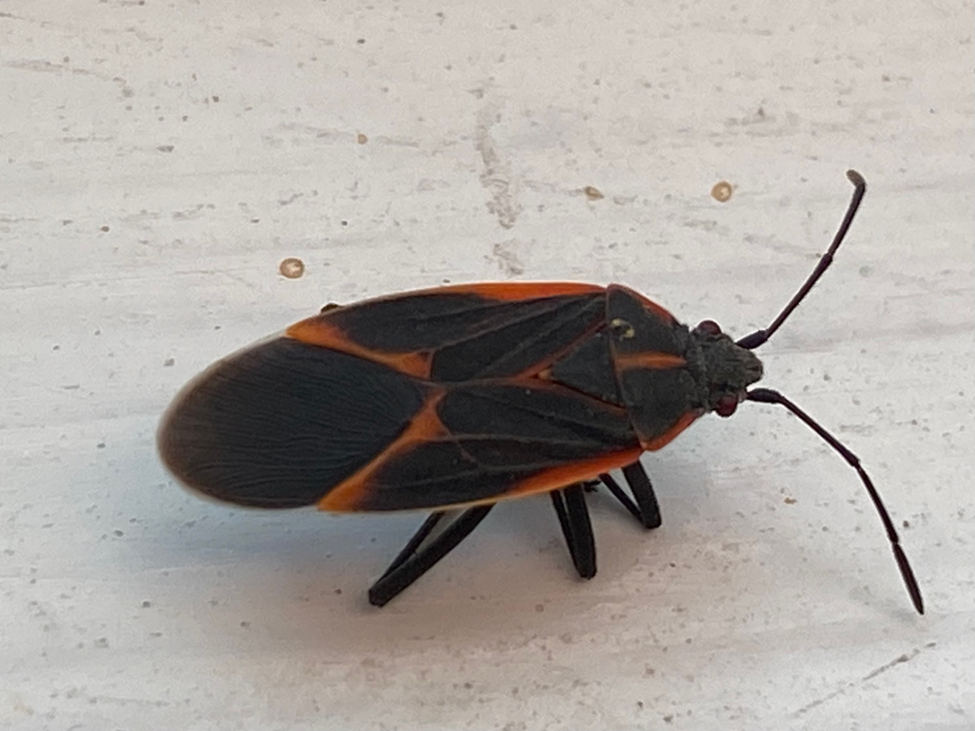
Have you been visited by clusters of almond shaped, 2-centimeter-long black bugs with red edges this spring?
Boxelder bugs (Boisea trivittata) have found their way into many of our homes. They are considered nuisance pests that do not generally transmit disease, bite or cause significant damage. But their feces can stain light-colored surfaces and they emit a noxious odor if they are smashed.
Typically they derive their sustenance by sucking nutrients from the seeds of the female boxelder tree (Acer negundo). Other hosts are trees within the maple or ash families, as well as grapes, apples, prunes, cherries, strawberries, and plums.
Eliminating these plants near your home is a first step in controlling the boxelder’s ability to “bug” you. In large clusters, boxelder bugs may affect the quality of small fruits.
Two generations are usually produced within a summer season, and the hot dry summer of 2025 was a perfect climate for reproduction. As birds do not find them appealing, this resulted in a bonus population seeking a warm place to overwinter. Spring has brought them out of their hiding spots to seemingly buzz randomly about when you assume they are all gone. So, how can we control these unwanted guests?
The first level of control is to seal any possible entryways into your home to exclude the bugs. Treat your home as a castle and make sure that boxelder bugs do not invade. Trim vegetation touching the house, clear leaf piles and any other debris near the foundations.
If a cluster of bugs is found near the foundation, a spray of warm water mixed at a ratio of 1 gallon per 5 tablespoons of liquid detergent will kill the insects. You will need to be careful of any plant material as it may be affected.
Boxelder bugs may easily gain entry to your home hidden on a potted plant, through an open door, slipping through a small rip in a screen, or on a piece of firewood. Check the siding, windows, doors, soffits, and foundations for any cracks, and eliminate areas that can become entryways. Caulk and seal carefully to eliminate all pathways of entry. As they thrive on sunny exposures, monitor the south and west sides of structures diligently.
Once boxelder bugs make it inside, the homeowner must focus on physical methods of removal. Your vacuum is a wonderful tool in this phase. Dispose of the bag promptly. If the vacuum collects waste in a reusable container, you may freeze the container overnight or eliminate the collected bugs in a soapy water bath to control the infestation. Try to limit touching the insects as the offensive odor can result from stress as well as physical contact.
If you can not bear to remove a female boxelder near your home, keep the ground below the tree cleared of the fallen seed pods, or consider planting a male (non-seed bearing) boxelder. Be vigilant in your use of your vacuum and work to safely seal your home to exclude unwanted house guests.
Learn more at:
Forest Insect and Disease Leaflet 95: https://www.fs.usda.gov/foresthealth/docs/fidls/FIDL-95-BoxelderBugs.pdf
NPIC National Pesticide Information - Boxelder Bugs: https://npic.orst.edu/pest/boxelder.html
Michigan State Extension: https://www.canr.msu.edu/news/boxelder_bugs_a_real_nuisance_during_spring

Master Gardener Volunteer Column

We openly share valuable knowledge.
Sign up for more insights, discoveries and solutions.