
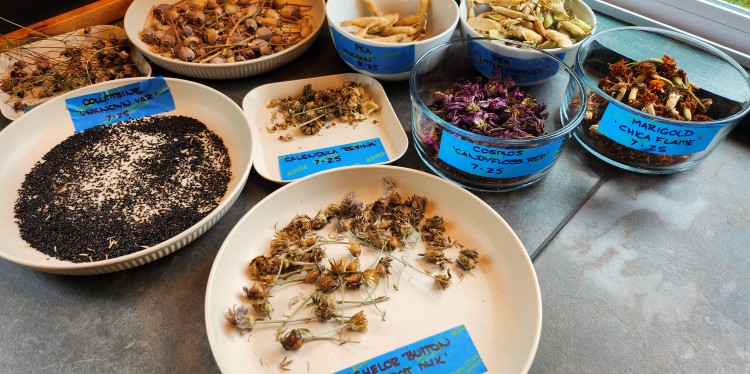

It’s August, and our gardens are in full swing — tomatoes ripening, flowers blooming, and plenty of growing still ahead. It's also a good time to start thinking about saving seeds. The Orleans Community Seed Share (OCSS) is a free community seed library, housed at the CCE Orleans office, where gardeners can pick up seed to plant and, in turn, donate seeds they've saved from their own gardens. It's a simple way to keep good varieties in circulation and put free, local seed into the hands of gardeners across Orleans County. As you're out in the garden this month, we'd love for you to consider setting aside a portion of what you save this Fall for the Seed Share.
Gather Your Tools and Containers
Now's a good time to gather what you'll need before seed heads start drying on the plant. A few simple items go a long way: small paper envelopes or paper lunch bags for collecting and storing seed (skip plastic — it holds moisture), scissors or pruners for snipping ripe seed heads or pods, a shallow bowl or tray for separating seed from chaff, and a pen or labels for noting the plant name and date. Having these on hand makes it easy to collect seed as it ripens through the season, rather than scrambling to find supplies once seed heads are already dry.
Dry Seed Collecting Basics
Dry seed saving works well for plants like beans, peas, lettuce, and many flowers and herbs — think zinnias, marigolds, cosmos, dill, and cilantro. Unlike tomatoes or squash, where the seed develops inside wet, fleshy fruit, these plants form pods, capsules, or seed heads that mature and dry right on the plant.
You'll know the seed is ready when the surrounding pod or seed head turns brown and brittle rather than green and pliable. An easy test is to press a seed with your fingernail — if it dents easily, it needs more time on the plant; a mature seed is hard and resists denting. Pods that rattle when shaken, or seed heads that crumble easily, are also good signs of readiness.
How you collect depends on the plant. Flower heads — zinnias, marigolds, cosmos — are best snipped whole into a paper bag once brown and papery. Then the seed is separated from the seed head over a bowl or tray. It's important not to skip that step: seed left sitting inside the seed head may not dry completely, which increases the risk of mold. Some seed heads also contain chemicals that can inhibit germination, so it's best to remove the seed from the seed head rather than store it there. Beans, peas, and other podded plants should stay on the plant until the pods are fully dried and beginning to split; then they can be picked and cracked open by hand.
Harvest on a calm, dry day if you can, and consider laying a tarp or sheet under plants before you start to catch any seed that drops. Skip plastic containers — they trap moisture and can cause mold, even in seed that looks dry.
For a closer look at dry seed collecting techniques, see our workbook Seeds to Splendor: Seed Collecting, Part 1 — Dry Processing.
Clean and Completely Dry: Why It Matters
This is the part we want to highlight this year. OCSS runs entirely on volunteer time, and we don't currently have the hands to clean seed heads or finish drying seed that comes to us. That means any seed donated to the Seed Share needs to arrive fully clean and dry.
"Clean" means the seed is free of pods, chaff, and plant debris. "Dry" means there's no moisture — even seed that feels dry to the touch can still hold enough moisture inside to mold in storage. A good rule of thumb: if a seed bends instead of snapping, or dents under a fingernail, it needs more drying time. Spreading seed out in a single layer on a tray, for a week or two in a dry spot, away from direct sun, usually does the trick.
Seed that's cleaned and dried properly will store for years and grow well for the next gardener who picks it up. Seed that isn't can mold, rot, or introduce disease to the whole collection — so this step really does matter.
How to Donate
When your seed is clean and fully dry, bring it to the Seed Share, where you'll find paper bags and donation forms ready for you to use. On the form, tell us as much as you can about the plant — variety, color, growth habit, anything that will help the next gardener. If you can't fill in every detail, that's alright too — we're grateful for whatever you can share.
Where: Outside the Harrington classroom, CCE Orleans Education Building, 12690 State Route 31, Albion.
When: Monday–Friday, 8:30 a.m. to 4:00 p.m.
A packet of well-saved seed is a small thing to give, but it keeps a variety going and puts free, local seed in the hands of someone else's garden next spring. Thank you for considering it.

We openly share valuable knowledge.
Sign up for more insights, discoveries and solutions.