

It is important to familiarize yourself with how late blight can appear in crop, and what diseases and conditions may be similar. The descriptions provide information on various potato diseases, and how their symptoms differ from late blight.
Late Blight
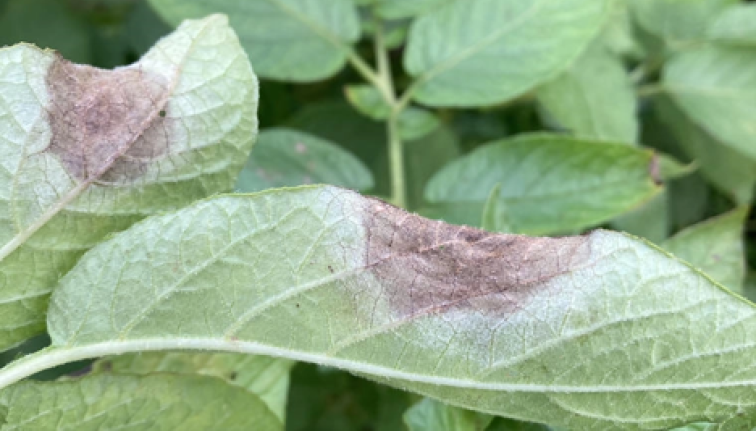
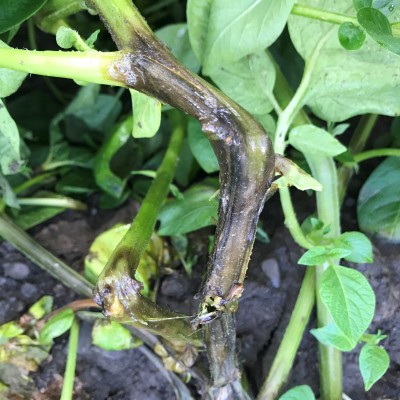
Late blight spreads during wet or humid periods, with higher disease incidence when it is cool and wet. Leaf symptoms: light to dark-green water-soaked spots that will turn brown over time, light green halo will form around the lesion, and white spores will form on the underside of leaves. When conditions are hot and dry like we have been experiencing lately, the brown lesions on the leaves can dry up and spores will disappear making it difficult to identify. Leaf lesions will cross over the mid-vein of the leaf if it comes in contact with the lesion. Lesions and white spores will also form on stems, especially at growing points. Attention should be given especially to parts of the fields that exhibit high humidity, such as low-lying areas, along hedgerows, near weedy patches, and near water.
Late Blight Sporulation
The underside of potato leaves showing sporulating lesions.
Photo provided by Ontario Crop IPM
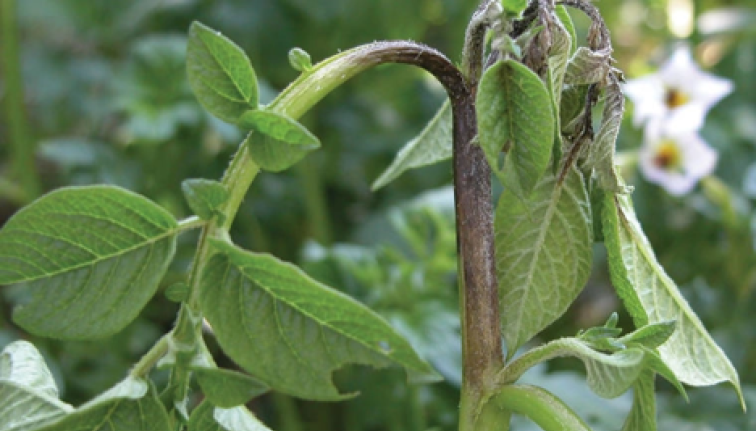
Late Blight on the Growing Point
The top growing point of a potato plant is brown and wilting as a result of late blight infection.
Photo provided by Ontario Crop IPM
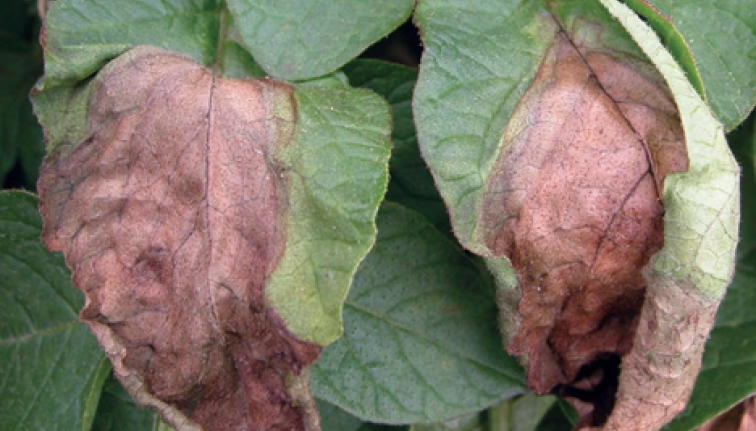
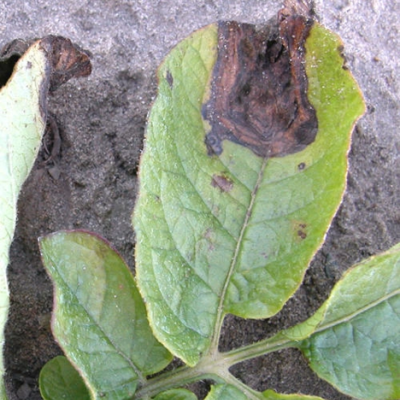
Late Blight in Dry Conditions
Under dry conditions, late blight will appear as dry brown patches.
Photo by Ontario Crop IPM
Lookalikes
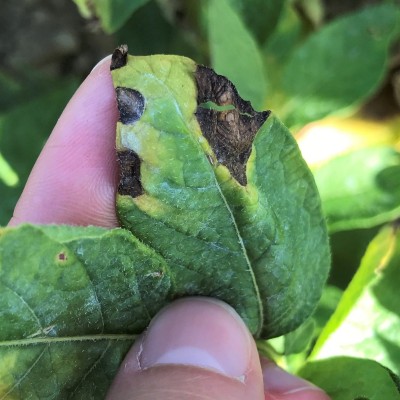
Early Blight
Brown circular lesions form on leaves with some yellow halos, and browning on stems. However, lesions form a concentric circle “bullseye” pattern with no white spores, and stem lesions show up as flecks instead of larger infected areas.
Photo by Margie Lund, Cornell Vegetable Program
Grey Mold
Dark lesions and mold spores form on leaves. However, lesions form a concentric circle “bullseye” pattern and mold spores are grey in color compared to the white spores that form with late blight. Lesions will form on the tips of the leaves and across the mid-vein like late blight, so looking for the concentric circle patter is a good indicator.
Photo by Ontario Crop IPM
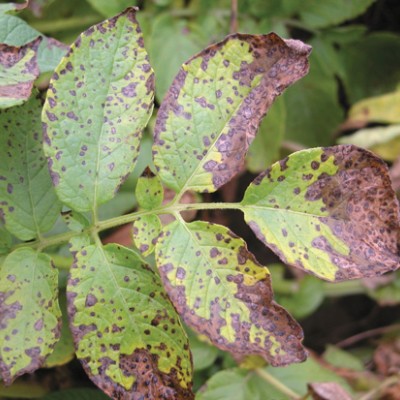
Alternaria Brown Spot
Brown lesions will form on leaves and stems. However, lesions usually start out very small and older lesions grow larger with a concentric circle “bullseye” pattern. Lesions on stems will be small and scattered spots.
Photo by Ontario Crop IPM
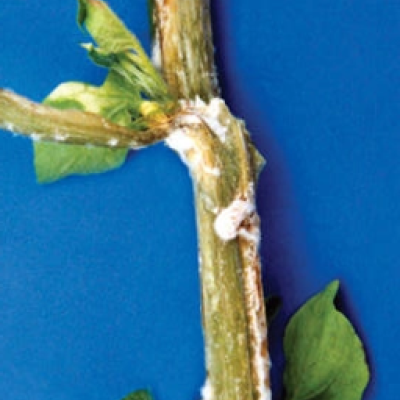
White Mold
White mold also has white spore growth on foliage, but this mold forms denser fungal growths and areas are not brown to black like late blight. Infected areas turn white in color and dark hard sclerotia will form on stems.
Photo by Ontario Crop IPM
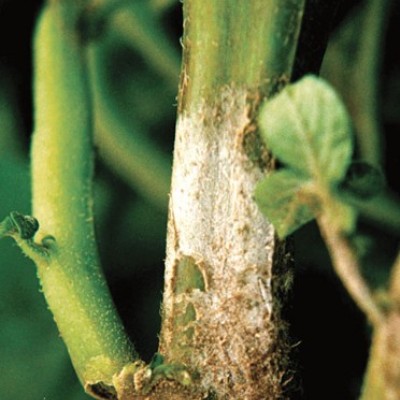
Rhizoctonia
White fungal growth also occurs on stems, but this growth can easily be wiped off and stem tissue under the fungus is not damaged.
Photo by Ontario Crop IPM
Blackleg
Blackleg causes blackened rotting stems in potatoes. However, no white fungal growth will develop, and plants will sometimes produce a fishy smell. Rotting stems develop at the soil line and work their way up the plant.
Photo by Margie Lund, Cornell Vegetable Program

Master Gardener Volunteer Column