• Agriculture
  • Vegetables
High tunnels, or soil-based greenhouses, help vegetable growers extend their growing season while increasing crop quality and yield. Within these intensive production systems where crop rotation and leaching events are limited, soil health and productivity decline over time due to fertility and compaction challenges, and rising pH, soluble salts, phosphorus and calcium levels.

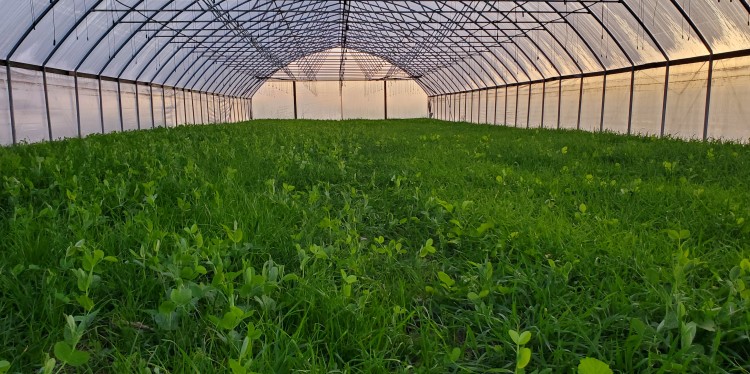
Cornell Cooperative Extension is researching cover crops for high tunnel growers to better manage fertility and improve soil health. In the field, cover cropping has well documented benefits. Cover cropping has this same potential in high tunnels to build soil health. Our work has shown that winter cover cropping in high tunnels has the potential to:

  • add organic matter
  • improve soil structure
  • support microbial activity
  • help with nutrient management by scavenging leftover nitrogen and/or fixing nitrogen

For example, over a two-year period, cover crop plots increased organic matter on average by 6.7% while bare ground plots increased organic matter on average by 1.5%.

We have been focusing on tomatoes as our primary crop, as over 80% of high tunnels in New York grow tomatoes. High tunnel tomato growers have limited options when it comes to implementing a cover crop into their crop rotation due to calendar constraints. The tomato season typically ends in October and begins again in March. This focused our efforts on a cover crop system during the fall and winter months.

Select a Cover Crop Species

The first step in cover cropping in high tunnels is choosing a species. When deciding what cover crop(s) to grow, think about your goals, crop rotation in the tunnel, management practices, and timing. The three main groups of cover crops to consider are legumes, grasses and brassicas. Benefits depend on which species are grown and how long they are in the ground.

Legumes are mainly grown for their ability to fix nitrogen from the atmosphere and add it to the soil. Other benefits include increasing organic matter and attracting beneficial insects. 

Grasses (grains) are grown for vigorous biomass production that can add organic matter, increase soil aggregation and reduce compaction. They are grown as catch crops that scavenge excess nutrients, especially nitrogen, to prevent leaching after the vegetable crop is done. Grasses will germinate in colder soils more so than any other cover crop type.

Brassicas are grown to reduce compaction, and for disease and pest suppression potential. 

Common Winter Cover Crops in High Tunnels in New York State

TypeExamplesRates (lb/acre)*Notes
LegumesField Pea60 to 140There are multiple varieties of field pea- Austrian Winter Pea is the most cold hardy.
Hairy Vetch15 to 40
Crimson Clover15 to 30
Red Clover5 to 15
GrassesTriticale60 to 200Order of cold soil germination, from earliest to latest: Wheat → Barley → Triticale → Rye
Winter Wheat60 to 120
Barley50 to 125
Cereal Rye60 to 200
Oats60 to 150
Annual Ryegrass10 to 30
BrassicasTillage or Forage Radish6 to 15Brassicas are very competitive in mixtures.
Turnip4 to 12
* Determining cover crop seeding rate: Seeding method, timing, and soil condition affect rate. Rates listed are a range of drilling and broadcast rates. The species rate will differ in a mixture and it’s important to consider a species’ competitiveness. Drilling needs a lower seeding rate than broadcasting. Seed providers can be excellent sources of information.

Cover Crop Mixtures

Cover crop mixtures are increasingly gaining popularity. In a mix, we may find multiple grasses, legumes and brassicas together. The mixture may present benefits as different species respond to the changes in light, temperature and moisture within a high tunnel over the winter months. Grass/legume mixtures are most common. When creating a mixture, it is important to consider how well the species will get along in terms of growth form and termination time.

High Tunnel Management Should Influence Species Selection

The equipment a grower has and whether they grow in permanent raised beds or not will all influence how cover crop biomass can be managed, terminated, and incorporated. Cover crops must be terminated at the appropriate stage of growth to maximize biomass and nitrogen contributions. For example, plant available nitrogen decreases in grain crops when they enter the boot stage and become ‘stemmy’. Consider how difficult it may be to manage a cover crop that is not terminated on time and goes to seed.

Timing Should Influence Species Selection

We have used planting dates from early September to the end of October. In general, our work shows the earlier you plant, the more biomass will be produced. Yet we have found some nuances and effects depend on the specific cover crop being grown. 

Our work has shown a trend that the earlier in fall you can plant a cover crop, the more legume growth you can achieve. If a later fall date is needed (in order to keep harvesting tomatoes), the grass becomes more important, and biomass is maximized in late winter.

Inoculate Your Legumes

Nitrogen fixation is often associated with legume cover crops but is done entirely by a group of bacteria called Rhizobacteria that live in nodules on legume roots. They have a mutually beneficial relationship—the plant provides food, water, and shelter, and in return, the bacteria pay rent in the form of fixing atmospheric nitrogen into ammonia, a form readily used by plants. Here are some things you need to know about that relationship to ensure successful nitrogen fixation:

  • While rhizobia are naturally present in the soil, high tunnel soils that have not had legumes present for many years, may have very low populations of rhizobia.
  • Your legume seed may need to be inoculated with the bacteria to jumpstart this symbiotic relationship.
  • Different species of legumes require specific species of rhizobia. Check with your seed supplier to ensure you’re buying the correct inoculant for your legume. 
  • Break open one of the nodules on the root of your legume cover crop. If there is a pink hue inside, that’s leghemoglobin, a protein that carries oxygen to the bacteria. Congrats! That means the bacteria are alive and well and nitrogen fixation is occurring.
  • Too much nitrogen in the soil can cause the rhizobia to be lazy. It’s much easier for the plant to take up N from the soil than trade for fixed N. Avoid fall applications of fertilizer. 

Terminating Cover Crops

Regardless of when you plant your cover crop, termination should occur at least two weeks prior to planting the next vegetable crop. This time allows residue to break down, returning nutrients to the soil, taking longer in cold soils. If not terminated and incorporated in a timely fashion, the cover crop residue will decrease nutrient availability for vegetable crops. 

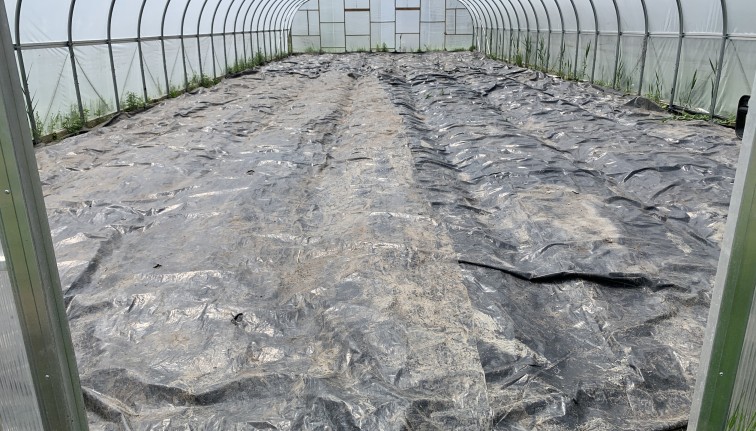
Common cover crop termination methods include mowing, tarping, rolling, and tillage. Chemical termination is not recommended under cover. 

Winter Kill Versus Winter Hardy

Some cover crop species are more winter hardy than others. Some species are described as “winter kill” meaning they will not survive freezing temperatures. They are grown for fall biomass production, die back in the winter still providing soil cover and make spring management easier. These can be a great choice for farms with less tillage options. Certain cover crops winter kill in field settings but can survive in high tunnel settings, for example oats and radishes. To achieve winter kill in a high tunnel, the grower may need to roll up the sides of the tunnel for a few weeks to achieve freezing temperatures.

Pest Outbreaks in Cover Crops are Possible

In our work, we have seen occasional pest pressure in cover crops but have yet to see a significant transfer to the following vegetable crop. As we are attempting to improve sustainability and soil health, we do not recommend pesticides for the control of pests on winter high tunnel cover crops. The most common pests in our trials are aphids and armyworms. Aphids (multiple potential species) can target all of the major cover crop families and can transmit viruses to vegetable crops, potentially leading to crop loss. In some situations, it may be advised to terminate and incorporate a cover crop early if there are extensive aphid populations.
 

Cultural Management Considerations

Promote Quick, Uniform Germination

As this crop won’t be exposed to rain, you’ll need to make sure it’s watered in well. The faster it germinates, the more time it has to grow before deep freezing temperatures! In our research, we’ve found a sprinkler set-up works well for ensuring wide, uniform coverage. Factor in your soil type and drainage when watering your cover crop in. In our trials, a single-day of watering helped germination and the cover crop did not need additional irrigation until spring.

Row Covers Can be Used to Help Maximize Biomass Production

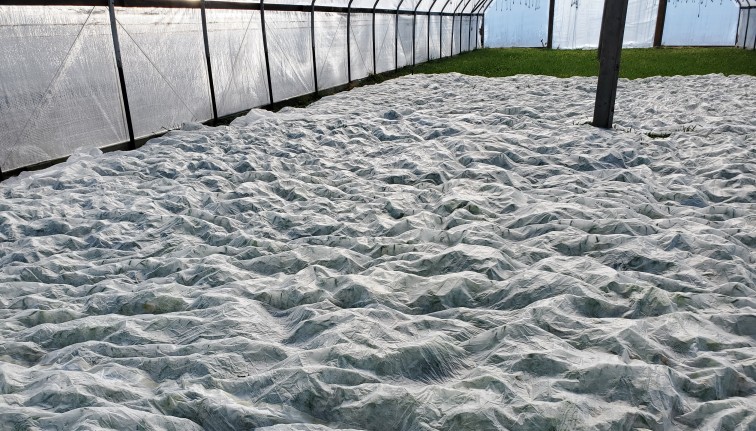
In our research, we have applied mid-weight row cover in January and left it over the cover crop until spring. Our work has shown a trend that the impact of row cover on biomass production may be more significant in later cover crop plantings.

Co-authored by

Lori Koenick, Extension Support Specialist, Cornell Vegetable Program

Funded by

This work is funded by a USDA NRCS Conservation Innovation Grant, “Best Management Strategies for High Organic Soils in Urban and Rural Vegetable Production.”