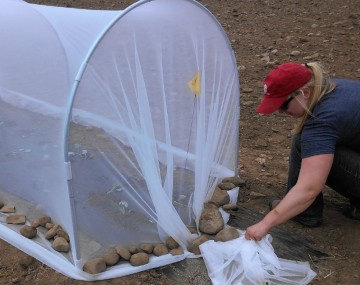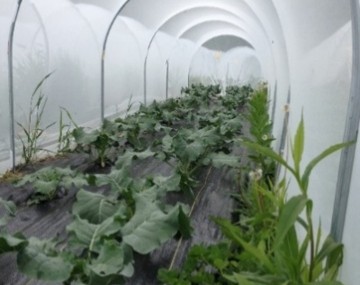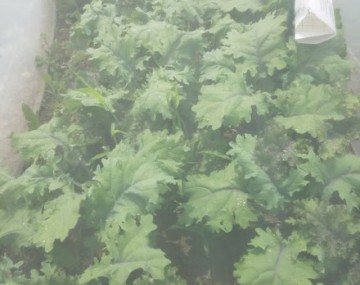

There are two methods to use insect exclusion netting (IEN), specifically ProtekNet, 25 g, to manage swede midge in brassicas:
- As a cover over top of susceptible brassicas to exclude/protect the crop from swede midge; and
- To include inside the netting swede midge that emerge from soil so that they cannot escape and attack susceptible brassicas outside the netting. In this case, a non-susceptible crop is grown under the netting.
Swede Midge is Tiny but Mighty
Swede midge is a tiny fly that lays its eggs deep in the growing points of brassica crops, and after the larvae (maggots) hatch, they feed on the young tissue which results in brown corky scarring, leaf puckering and twisting, multiple growing shoots or heads, and/or no head at all. Swede midge feeding damage in cabbage, broccoli, cauliflower/Romanesco and kohlrabi can render the marketable portions unmarketable, while feeding on kale and collards reduces marketable leaves/yield. Organic management of swede midge is dependent on disrupting the swede midge life cycle. Swede midge overwinter in the soil as pupae and emerge as adults (flies) around mid-May, which have 3 days to find a mate and a suitable host to lay eggs. After 3 days, larvae hatch and feed for 1 to 3 weeks, before dropping to the soil to pupate before emerging as adults in another 1 to 2 weeks. In total, the swede midge lifecycle is 21 to 44 days and there are 4 to 5 overlapping generations per season on New York.