

- Agriculture
- Vegetables
How do urban soils differ? Why does this matter when interpreting soil test results?
Due to a history of human land use and ongoing activities, urban soils are often compacted, contaminated or of poor quality. Because of this, many urban growers produce crops in constructed soils. Urban agricultural soils are commonly referred to as “constructed” when they are made or heavily amended with materials brought in such as screened topsoil, compost, mulch, yard scraps and manures in raised beds. Due to smaller spaces, there are limited options for crop rotation on urban farms. It is possible for this continuous intensive production to lead to gradual reduction in soil fertility and tilth.
When compared to rural agricultural soils, urban agricultural soils are more likely to have a combination of higher organic matter, pH, contaminants and soluble salts, lower bulk density, and shallow depth. Soil tests are useful, and urban growers will need to adapt the results and recommendations to their urban setting. swa39 [at] cornell.edu (Email Sam Anderson), Urban Agriculture Specialist, for details on how to submit an urban soil sample and adapting the results to your urban farm.
This article will discuss how organic matter, nitrogen, potassium, bulk density and pH, as well as considerations for growing under a high tunnel, will impact your soil management.
Commercial Soil Testing
It is useful to note that most commercial soil tests ask for the soil name or texture on the submission form. The labs use this information as the basis of their interpretation and recommendations.
Soil Name
Soil name is a classification that can be found in the Web Soil Survey from USDA-NRCS, yet it is important to note that most urban soils have the generic classification of “urban land.”
Texture
Texture is the relative amount of sand, silt and clay particles in the soil; soil texture affects most of the chemical, biological and physical processes in the soil. Organic matter and rocks are not considered as part of a soil’s texture.
Organic Matter
Soil organic matter is a measure of the carbon-containing material that comes from living and dead organisms, or what may be simply described as the living, the dead, and the very dead. Organic matter affects nearly all other soil properties, including nutrient cycling, soil structure, and water availability.
Constructed soils for urban agriculture often have a high proportion of organic matter as compared to their rural counterparts, usually in the form of large volumes of compost. In New York City, urban ag soils typically have organic matter ranging from between 8 and 15%, with some as high as 30%. There are many advantages to the high organic matter in urban ag soils including:
- Well-balanced water retention and drainage
- Low occurrence of compaction
- Improved tilth
- Steady supply of some macronutrients (especially phosphorous, calcium, and magnesium) and most micronutrients
- Slow release of nitrogen as organic matter decomposes
Compost typically provides many of the nutrients needed for plant growth, but vegetables and other crops may benefit from more potassium (K) and nitrogen (N) than compost alone can provide. For example, many urban farmers see improved yields by adding potassium sulfate at spring planting.
However, with high levels of organic matter, we may also see some challenges:
- May dry out fast, especially highly organic soils that are newly constructed or frequently tilled
- High pH related to excess nutrients
- Excess N becomes available often in late spring/early summer
- With excess nitrogen and phosphorous, there is potential for leaching, downstream eutrophication, and other water quality concerns
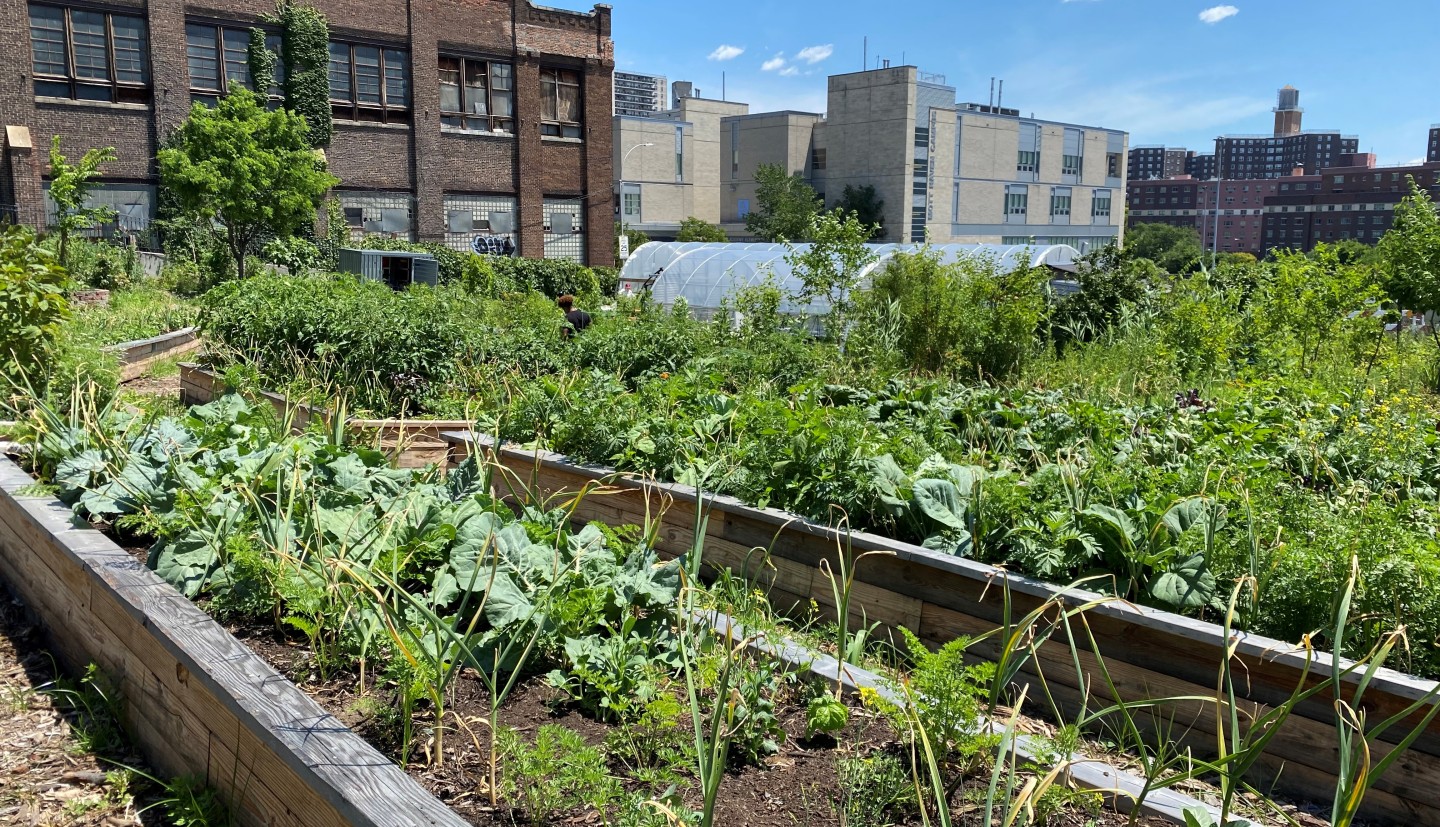
Constructed Soils
Facing poor quality soils, many urban growers produce crops in “constructed” soils in raised planting beds.
Nitrogen: The Jolly Green Giant of Nutrients
Nitrogen (N) is often the nutrient of primary management concern for urban and rural farmers. There are several reasons why:
- N is among the soil nutrients used in highest quantity by produce crops (up to several hundred pounds per acre per year!)
- Decomposing organic matter releases N, but rates of availability depend on soil microbial activity.
- N is highly influential in shoot production, which influences the yield potential of all fruits and vegetables, as well as the plant’s ability to make use of other soil nutrients.
- N is highly mobile and often will escape the root zone through volatilization (in the air) or leaching (down through the soil profile) before it is taken up by the crop, resulting in economic and environmental losses.
Urban farmers face some unique challenges around N management. Since most urban ag soils are high in organic matter, there is a considerable bank of N in the soil itself. However, it is difficult to predict when soil microbes will ‘mineralize’ this N into plant available forms such as nitrate N. We often observe a flush of nitrate N released from high organic matter soils in late spring, when temperatures and moisture favor mineralization, resulting in excessive vegetative growth, leading to foliar disease and delayed maturity of fruiting vegetables.
For this reason (and to avoid loss) we do not recommend large additions of N fertilizers to high organic matter (OM) soils. Bulk forms of N, such as feather or soy meal, are common fertilizers on rural organic farms, however the release of nitrates from these sources is similar to soils with high organic matter soil. We suggest more frequent but modest applications of soluble forms of N (such as side dressing blood meal), or where drip irrigation systems are in place, the injection of a soluble source of N at modest rates on a weekly basis to avoid excess levels and loss. Or for some urban growers, such as community gardeners, it may be acceptable to not apply any additional nitrogen.
How much N does organic matter release?
Estimates vary, but a safe assumption is that a soil with 1% OM will release around 10 lbs of N per acre per season. For example, an acre soil with 10% organic matter may release 100 lbs of nitrogen over the course of the season. Our challenge is knowing when this will be released and balancing it with crop demand. Crop demand beyond existing soil supplies can be estimated on a weekly basis. Taking the remainder of the N needs of the crop not met by mineralization, we can divide the amount of N desired by the anticipated number of weeks the crop will be in the ground.
Example: How much fertilizer should an urban grower add to a tomato planting each week?
- Tomatoes may need as much as 150 lbs of N per acre.
- An urban farm with soil with 10% OM releasing 100 lbs of N per season.
- The grower has 12-15-30 fertilizer on-hand.
- The tomato production area on the urban farm is 0.1 acres.
For tomatoes that need 150 lbs of N per acre, with a soil having 10% OM releasing 100 lbs of N per season, the farmer will need to supplement 50 lbs of N to meet the needs of their tomatoes.
150 lbs/acre N needed - 100 lbs/acre N from the soil = 50 lbs/acre of N supplement
Divide the needed amount (50 lbs/acre) over the lifespan of the crop.
You should account for reduced nutrient needs if your crop growth rate decreases at the end of it cropping cycle. In this example, tomatoes would easily have a 20-week lifespan if transplanted on May 1 and terminated on October 1. But their nutrient needs dramatically decrease 15 weeks after transplant, so we can estimate the nutrient needs over 15 weeks.
50 lbs/acre ÷ 15 weeks = 3.33 lbs/acre N per week
Not all fertilizer is the same so you will need to know how much of the desired nutrients are in the fertilizer. All commercially available fertilizers in the United States are required to provide nutrient weight percentages on the fertilizer bag or bottle. This usually comes in three consecutive numbers, where each number represents the percentage of nitrogen (N), phosphorus (P) and potassium (K), or N-P-K. For this example, a fertilizer labeled 12-15-30 contains 12% nitrogren (N), 15% phosphorus (P), and 30% potassium (K).
How much of this fertilizer (unknown value of X) with 12% N would we need to reach our goal of 3.33 lbs/acre per week?
0.12(X) = 3.33 lbs/acre N per week
Divide both sides of the equation by 0.12 to solve for X:
X = 3.33/0.12 = 27.75 lbs of fertilizer per acre per week
Most urban farms are not growing on the acre scale, so it is essential to be able to calculate on the actual acreage or square footage* being fertilized. An urban farm with a tomato production area of 0.1 acres would need 1/10 of the amount of 12-15-30 to achieve a weekly rate of 3.3 lbs/acre N.
27.75 lbs/acre fertilizer ÷ 10 = 2.775 lbs of fertilizer per week
To achieve even more effective nutrient uptake, alternating with clear water irrigations, growers could further divide this rate into 2-3 applications per week to create a more uniform soil status and more productive plants.
* It should be noted that many nutrient recommendations now come with an additional 100 sq foot recommendation. To calculate how much fertilizer is needed for any size smaller urban farm, keep in mind there are 43,560 square feet to an acre. So, when given acre application recommendations, just divide by 43,560 and multiple that by the actual square feet of growing area.
Potassium
Potassium (K) in another ‘macro nutrient’, and like N, crops use hundreds of pounds per acre per year. K is essential for flower development and fruit quality. When crops are low in potassium, foliage will become discolored, and the plant drops flowers and fruit. Our data reveals that this is the most common deficiency in urban vegetable crops, particularly tomatoes.
K is nitrogen’s pal, as we can calculate application rates based on anticipated levels of N. For example, tomatoes in their fruiting stage will use K at almost 3X the rate of N. For vegetative crops, like collards and kale, this ratio is closer to 1:1.
Fortunately, K is not quite as mobile as nitrogen in the soil, and we can pre-plant apply K in bulk forms based on soil tests and projected crop demand. K uptake is influenced by soil pH and the relative value of other crop nutrients in the soil. Avoiding excess levels of phosphorus, magnesium and calcium will also help achieve potassium at appropriate levels in the crop. Further, it is important to consider bulk density when deciding on K applications because lab analysis in high OM soils with low bulk density will be overestimate K levels.
Bulk Density and Soil Test Interpretation
When you get a soil test, the results will generally include the estimated amounts of key plant-available nutrients. Some labs return these levels in parts per million (ppm), but often they’re communicated in pounds per acre (lbs/acre).
Standard soil tests are often built on an assumption that all field soils have roughly a similar bulk density. Bulk density is a measurement of a soil’s dry weight for any given volume, often shown as g/cm3, and is strongly impacted by pore space and organic matter. The problem is that in soils with especially high levels of organic matter—such as many urban ag soils—the bulk density is lower than these “typical” mineral rural agricultural soils. The average bulk density of mineral rural agricultural soils are between 1 and 1.4 g/cm3, though clayey soils can have higher densities. Meanwhile, constructed soils of urban agriculture commonly have bulk densities between 0.5 and 0.8 g/cm3.
This results in nutrient tests giving artificially high estimated amounts of key plant-available nutrients which discourage urban farmers from adding needed nutrient amendments. This effect is particularly pronounced with potassium (K), where a soil test says there is plenty of potassium available in the soil, when in reality, there is a deficiency. After you measure the soil’s bulk density, a simple calculation can be used to provide accurate potassium application rates. The formula for this conversion factor is:
soil bulk density (g/cm3) x ppm x 1.5 = lbs/acre
In this formula, multiply the bulk density times the ppm of K given in the soil test times the conversion factor of 1.5 to get an accurate application rate.
High pH – What are the implications?
Soil pH or acidity affects how available soil nutrients are for plant uptake. For most crops, the ideal pH range for nutrient availability is 6.0 - 7.0 (Figure 1). Due to human activities, the majority of urban agricultural soils in New York State exhibit a pH between 7.0 and 8.0. This elevated pH range can impact vegetable crop health and reduce yields by making certain nutrients less available for plant uptake. For example, manganese availability is reduced at high pH, and as a result it is commonly deficient for crops on urban farms with high levels of organic matter. High pH can also result in deficiencies of phosphorus, iron, copper, and boron.
Where there are many resources available on how to raise soil pH, information is more limited on strategies to lower soil pH. A common strategy for managing soils with high pH is amending with sulfur. Some less common approaches include additions of acidic peat moss or composts. Sulfur enriched products come in pelleted or powdered forms. Some people find pelleted forms easier to work with, though they may act on pH more slowly than powdered forms. Sulfur is also used as a fungicide, so make sure the product you use is labeled for soil and pH adjustment.
Our work has demonstrated that pH adjustment of urban soils by amending with elemental sulfur can lead to increased plant nutrient availability and overall crop health.
Follow these guidelines when applying sulfur products:
- When considering when to apply sulfur amendments, growers generally apply before planting or after harvest. Fall application is recommended, as applying close to planting has a risk of burning plant roots.
- When deciding upon application rates, the soil texture and pH need to be considered (Table 1).
Table 1. General sulfur recommendations for different soil textures. Application rates are in pounds/acre of sulfur to lower soil pH to 6.5. To convert pounds/acre to pounds/100 ft2, divide by 436. Source: Cornell SoilNOW
| Initial Soil pH | Sulfur Application Rates (lbs/acre) | ||
|---|---|---|---|
| Sands/Gravel | Loams | Clays | |
| 8.5 | 2000 | 2500 | 3000 |
| 8 | 1200 | 1500 | 2000 |
| 7.5 | 500 | 800 | 1000 |
| 7 | 100 | 150 | 300 |
Urban High Tunnel Considerations
High tunnels, or soil-based greenhouses, help urban growers extend the growing season while increasing crop quality and yield. As with urban soils in general, soil pH tends to be higher in high tunnels. As these soils are covered most or all of the year, leaching events (rain or snow) are limited, which means that soluble salts coming from fertilizers, composts, and irrigation water will build up over time. These salts, which would otherwise rinse out with rainfall, can build up in the soil, further raising the pH. Additionally, high temperatures under the tunnel can accelerate this process. As salt levels increase, it becomes more difficult for plants to absorb water from the soil.
There are some management considerations and options to deal with this salt buildup. First, add a soluble salts test to your annual soil test to keep track of the salt levels. Second, to remove excess salts, increased leaching is a common and effective option. This can be done in a few ways, such as by removing the covering every three years during winter or flooding the tunnel every few years to flush out excess salts. Finally, growers may have the option of acidifying irrigation water with sulfuric or citric acid to help reduce the pH in the soil.
Contaminants
While the focus of this handout is on building soil fertility, it is important for urban growers to keep in mind that contamination by lead, other metals, or other chemicals is a concern for urban soils. There is existing guidance on soil testing for contaminants and mitigation strategies.
Soil Lead Screening – updated fact sheet from New York Soil Health – 2024
Sources and Impacts of Contaminants in Soils – Cornell Waste Management Institute Fact Sheet – 2015
Prepared by
Lori Koenick, Extension Support Specialist, CCE Cornell Vegetable Program
Sam Anderson, Urban Agriculture Specialist, CCE Harvest New York
Jonathan Russell-Anelli, Senior Extension Associate & Senior Lecturer, Soil and Crop Sciences Section, School of Integrative Plants Sciences, Cornell University
Judson Reid, Vegetable Specialist, CCE Cornell Vegetable Program
SoilNOW, Cornell University
Cornell Soil Health Laboratory, Cornell University
Management Practices for High Organic Matter Soils: Urban Case Studies, 2024, CCE Cornell Vegetable Program, CCE Harvest New York
Healthy Soil - Garden Guidance, Cornell Garden Based Learning
Schulte, E.E., and Kelling, K.A., 1999. Understanding Plant Nutrients – Soil and Applied Manganese
Magdoff, F. and Van Es, H., 2021. Building soils for better crops (Vol. 4). Beltsville: Sustainable Agriculture Network
Beniston, J. 2024. Basics of Urban Soil Health. Technical Note No. 470-02 Soil Health USDA NRCS.
This work is supported by SoilNOW and funded by a USDA NRCS Conservation Innovation Grant “Best Management Strategies for High Organic Soils in Urban and Rural Vegetable Production.”