• Agriculture
  • Vegetables
Row covers can be an effective pest management and season extension tool for urban growers. Row covers act as barriers physically preventing pests—insects, birds, mammals—from reaching their host plant. They are typically a temporary pest management tool designed to be put on and taken off during the growing season, often early in crop cycles. This fact sheet is based on our experiences using row covers for pest management on urban farms in New York.

Row covers can be an effective pest management and season extension tool for urban growers. Row covers are fabric barriers placed either directly over crops or supported on frames (creating low tunnels). There are a variety of fabrics available that differ in weight, permeability, durability, and costs. 

  • Row cover commonly refers to non-woven polyester or polypropylene (poly) materials that vary in weight offering different levels of frost protection that is used for season extension and pest management. This is also referred to as floating row cover.
  • Insect netting commonly refers to a mesh netting that is lightweight; permeable to light, water, and air; and is used for pest management (but not season extension). Insect netting is generally a finer mesh, more durable and more expensive than floating row cover. 

Row covers act as barriers physically preventing pests—insects, birds, mammals—from reaching their host plant. They are typically a temporary pest management tool designed to be put on and taken off during the growing season, often early in crop cycles. 

Learn About the Pest’s Biology and Life Cycle

When using row cover to manage a specific pest, it is helpful to do some research on the pest’s biology and life cycle. Certain pests, like flea beetles and swede midge, overwinter in the soil or nearby the growing area in weeds and plant debris. It is much more effective to use row cover in areas that are not already infested by the pest you are trying to manage. Remember: Row cover is a protective measure; install it before the pest arrives on the crop!

When using insect netting, it is important to note the pest’s size to make sure the mesh “grade” (size) is small enough to exclude your target pest. For example, for a tiny pest such as swede midge with adults being 1.5 mm in length, a mesh size of 0.35 mm (25 gr/m2) is recommended.

Think About the Crops

Beyond the pests, you should think about the crops that will be covered: how tall they get, ideal temperature range and pollination. Depending on fabric and weight, row covers can significantly increase temperature of the growing environment and other conditions such as moisture. It is important to scout regularly under the row cover, making note of any pest pressure and environmental conditions. If any pests are present under the row cover, their population can increase rapidly without the presence of natural enemies. In addition, weed management can be a challenge under row cover. It’s helpful to plan ahead such as mulching before installing the row cover.
 

Example 1: Using Row Cover to Manage Flea Beetles on Collards and Eggplant

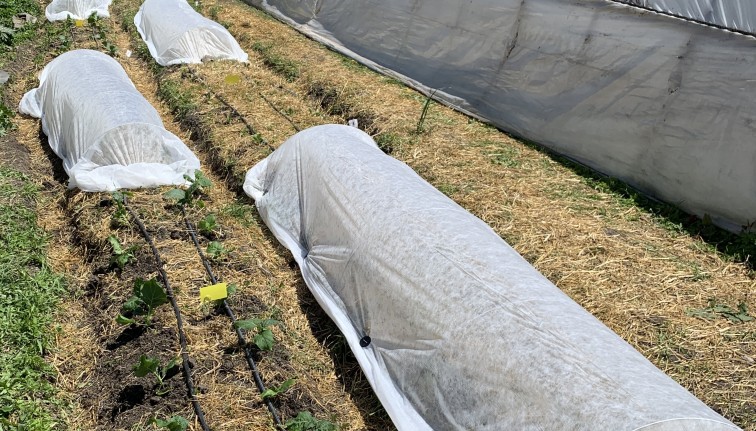
A collaborating farm in Buffalo hosted a demonstration trial looking at using row cover to manage flea beetles on collards and eggplant. As flea beetles emerge and start causing damage to seedlings in late spring, row cover (0.5 oz weight) was stretched over 64” wire hoops to form low tunnels at time of planting. Row cover was removed from eggplant plots at the end of June, when plants started to flower, and from collards in early July, when leaves began touching the row cover. It’s important to keep fabric from touching the plants as this can cause sunburn and insects can nibble through the mesh. After row cover was removed and as the season progressed, flea beetle damage levels appeared to even out in covered and non-covered plots. Yet despite similar damage levels, farmers qualitatively reported horticultural benefits to plants from row cover. The farmer observed more flowers and darker green foliage on plants under row cover. Plots covered early in the season produced higher yields than plots without row cover.

Timing

Row covers are applied at time of planting or at a time when plants are most vulnerable to a pest. They can be removed at flowering or at a specific time of year or left on for the duration of the season. For crops that require pollination such as cucumbers and peppers, growers typically either remove row cover prior to pollination, regularly open covers to allow pollinators in, or bring in pollinators.

When installing, make sure row cover edges are sealed and secure to the soil. Rocks, sandbags, bricks, or burying the fabric edge in the soil can be helpful. If you need to get under the row cover for weeding or harvesting, be sure to re-seal the edges afterward. Repair holes in fabric if possible.

Example 2: Using Insect Netting to Exclude Cucumber Beetles

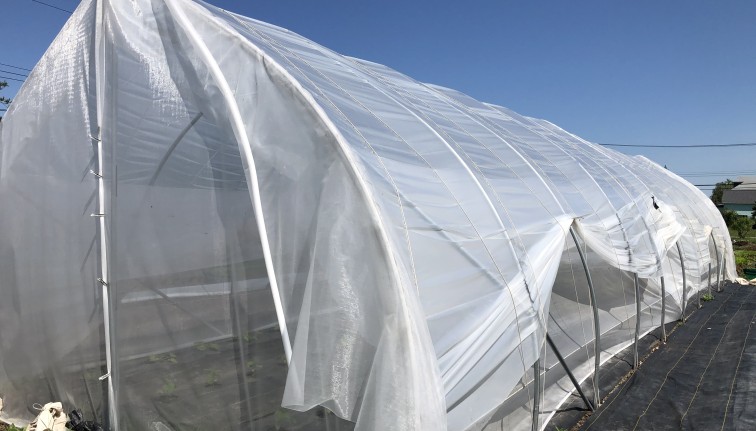
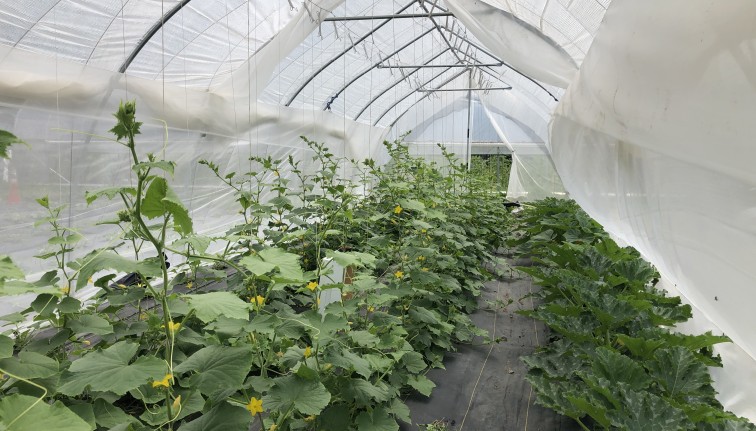
A collaborating farm in Buffalo hosted a two-year demonstration trial of using insect netting on a caterpillar tunnel (14’x50’) for exclusion of cucumber beetles on squash and cucumbers. In both years, insect exclusion netting (ProtekNet Exclusion Netting, FIINTE3, 2x50-47) was applied prior to cucumber beetle emergence. This multiyear trial showed there are trade-offs and there is a learning curve with insect netting.

Both years showed that insect netting appeared to provide sufficient protection of squash and cucumber plants from cucumber beetles. Yet in year one, the farmer reported any time saved in harvesting and sorting was offset by time spent installing the netting, and dealing with pollination and pest issues. The cucumber plants struggled from lack of pollination due to not being a parthenocarpic (not requiring pollination) variety and the exclusion netting further inhibited pollinators from entering the tunnel. To remedy this, the farm moved frames of bees into the tunnel. Pollination thereafter seemed adequate but noticeably lower. Another approach would be to grow parthenocarpic varieties under the netting. Twospotted spider mite (TSSM) damage was noted to be significant in the latter part of the season. 

Learning from experience in year two farmers grew parthenocarpic cucumber varieties and released a predatory mite, Phytoseiulus persimilis, to manage TSSM damage. In year two, the farmer reported increased crop quantity and quality, length of harvest window, and income from growing cucumbers under exclusion netting. 

Prepared by

Sam Anderson, Urban Agriculture Specialist, CCE Harvest New York

Lori Koenick, Extension Support Specialist, CCE Cornell Vegetable Program

Judson Reid, Extension Vegetable Specialist, CCE Cornell Vegetable Program

Using Row Cover and Exclusion Netting at Common Roots Farm, Buffalo, NY. 2021. CCE Harvest NY YouTube

Row Covers. 2020. Utah State University Extension

Row Covers. 2023. University of Maryland Extension

This material is based upon work supported by the National Institute of Food and Agriculture, U.S. Department of Agriculture, through the Northeast Sustainable Agriculture Research and Education program under subaward number [LNE21-421 “Sustainable Pest Management for New York Urban Farmers”]. Fall 2024.