

- Agriculture
- Vegetables
Propagation
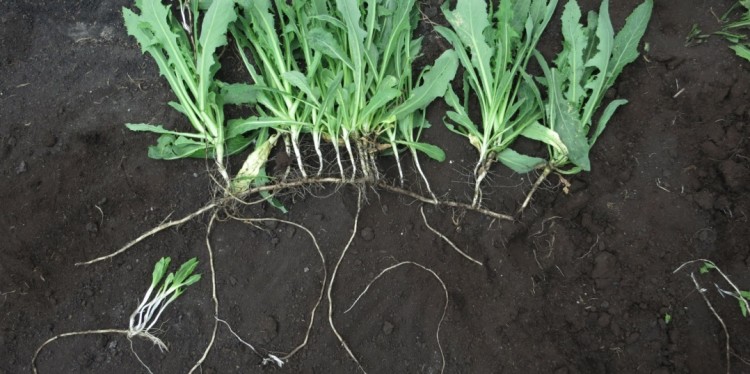
Tillage and other field operations serve to propagate these rhizomes. Each pass with a chisel plow, for example, will distribute rhizome pieces up a field. New horsenettle plants, for example, can emerge from a ¼ inch long segment buried a foot below the surface. As you can imagine, this makes mechanical control challenging. The key management objective for all perennial weeds is to kill the overwintering underground tissues. In the case of perennial rhizomatous weeds, this is often most efficiently achieved through the use of translocating herbicides applied between mid-summer and early fall.
Use of Herbicides
Translocating Herbicides
Translocating herbicides are taken up by the plant and move in the phloem, following the flow of sugar to the strongest, most actively growing sinks. In late summer and early fall, perennials are sending resources to the overwintering structures, like rhizomes, to prepare for winter. In the spring, resources are flowing from the below ground rhizomes to the new shoots, and the rhizomes are being physically depleted. Around bloom that balance begins to shift for many perennial species as they partition more of their photosynthetic resources to the underground overwintering structures. Thus, applications of translocating herbicides are often more effective in the long run when applied at or after bloom. They do have a place for use in the fall, but the window is closing. Importantly, glyphosate efficacy drops appreciably when weather is below 50 degrees during application and in the following uptake period.
Glyphosate and many of the Group 4 herbicides are examples of translocating herbicides. Other herbicides can be fall-applied to target rhizomes on a case-by-case basis. Translocating herbicides work best when the weeds are unstressed and of an appropriate (label specified) size at time of application. The weeds should remain undisturbed for a couple weeks following application to achieve the greatest effect. Adjuvants, tank-mix partners, and water alkalinity can all influence the efficacy of some common translocating herbicides. Use caution when applying translocating herbicides near horticultural crops. Read labels carefully regarding crop safety and environmental conditions at application. Rotational restrictions need to be carefully considered, especially with Group 4 herbicides!
Pre-Emergent Herbicides
Pre-emergent herbicides generally have little impact on emerging rhizome shoots because they are designed to control seedlings, not established plants. In-season contact herbicides can knock back the top growth of most perennial rhizomatous weeds. This has a two-fold effect on the rhizomes:
- reduces the amount of photosynthates transported to below-ground storage
- can force the rhizome to further expend energy reserves by generating replacement shoots
Cultural and Mechanical Control
This two-fold approach underpins the cultural and mechanical control strategies for rhizomatous broadleaf perennials. Step 1 is to weaken the rhizome by depleting the energy reserves. Step 2 is to limit the amount of energy that is allowed to go back into the ground to replenish old rhizomes and grow new ones.
Rhizome depletion occurs every time new shoots emerge. The larger the rhizome, the more energy it has to grow shoots. Keep in mind that not every bud on a rhizome turns into a shoot – several are held back in case the plant needs to regenerate shoots. Here two tactics to develop:
Forced Depletion via Recurrent Regeneration
Start with smaller rhizome pieces and always keep them sending resources upward. Do this by eliminating shoots several times over the course of the season using cultivation, tight mowing, etc. However, and this is critical: taking a mechanical approach means committing to making many control passes throughout the season. Remember that every time ground infested with rhizomatous perennials is worked the weed is propagated and there are many times more weeds to control. That means there are many more opportunities to lose control of individual plants and make the problem worse if repeated operations to limit top growth do not occur or are ineffective. Be careful not to spread the rhizomes while cultivating – work towards the center of the patch and remove dangling rhizome pieces from equipment. Successfully eliminating top growth multiple times not only depletes rhizomes, it also effectively limits the development of new rhizomes and reduces seed production. This tactic can be used to reset the stage of top growth so weed size better aligns with heights specified on translocating herbicide labels.
Limit Carbohydrate Storage via Induced Stress
Perennial weeds are less likely to overwinter if they have weak rhizomes. They also are less tolerant of other stresses. For example, heavy competition from cover crops, drought, or disease have a better chance of finishing off a weak rhizome than one left to grow all summer. This same logic applies to fall herbicide use – a weaker rhizome is easier to kill. Rhizomatous perennial problems are the perfect scenario for making full use of as many tools in the weed control toolbox as possible, to best exploit all the weaknesses in the biological cycles of these difficult plants. Unfavorable crop rotations, dense cover crops, and narrower crop rows or higher planting density are some examples of other toolbox techniques that will stress perennial weeds. Note that to date, use of use of light exclusion or solarizing methods (tarping) for long-term suppression or killing of rhizomatous perennials is not proving successful in the Northeast.
Control the Plants Before Seed Matures
In the long term, seeds deposited into the seed bank can permit re-infestation down the road. Next field season, aim to control the plants before the seed can mature by attacking populations shortly after flowering begins. Cultivation can be insufficient to deal with large escaped plants in bloom, and the timing often prohibits herbicide use within a vegetable field. In these cases, consider taking a mower or weed whacker to patchy, isolated stands of large weeds that are in bud or flower. Many weeds can finish immature seeds on severed portions of the plant so strive to make timely mowing-type operations, especially if the weeds have already flowered. Luckily, seedlings are far easier to kill than established plants. When caught early, mechanical or chemical control can be effective against seedlings of perennial rhizomatous weeds.
Tackling perennial rhizomatous weeds may be a multi-season task, but it is achievable. With a good weed map, multifaceted approach, and perseverance, these troublesome weeds can be defeated.