• Agriculture
  • Vegetables
Plant diseases are an inevitable part of vegetable production. Every plant species can be infected by pathogens—biotic disease-causing agents—such as bacteria, fungi, viruses, and nematodes. On vegetable crops, damage can range from slight to severe. There are several control options but, for some crop and disease combinations, perhaps the most straightforward cultural control—and often the most effective—is to select a variety of the crop that has been bred for resistance to the disease.

For vegetable farmers, both urban and rural, plant diseases are an inevitable part of the growing season. Every plant species can be infected by pathogens—biotic disease-causing agents—such as bacteria, fungi, viruses, and nematodes. On vegetable crops, damage can range from slight to severe. For example: Fusarium wilt, a soil-borne fungal disease, often wilts only a few tomato plants while leaving the rest unaffected; late blight, an oomycete disease with airborne sporangia, can devastate a whole field of tomatoes in a matter of days. 

What can urban farmers do about this? For some of the trickiest plant diseases, preventative fungicide applications can help; however, many urban farms prefer to avoid chemical fungicides or are not permitted to use them. Cultural controls, such as crop rotation, reducing leaf wetness, and sanitizing tools, remain important. However, for some crop and disease combinations, perhaps the most straightforward cultural control—and often the most effective—is to select a variety of the crop that has been bred for resistance to the disease.
 

Start by Selecting a Disease Resistant Variety of Seed

This preventive measure can be simple: Seed catalogs will often list information about each variety’s disease resistance. When you are purchasing seeds for a vegetable crop, choose the varieties with listed resistance to the diseases you’re most concerned about. Unfortunately, a resistant variety will not always be available for your crop-disease combination; for example, you won’t find commercially available tomatoes with resistance to bacterial canker. However, some common diseases can be nearly eliminated with the use of resistant varieties; for example, several tomato varieties are highly resistant to leaf mold (Fulvia fulva).

This also requires some planning, some information-gathering, and probably some additional research. Here are some questions to ask yourself before ordering seeds:

  • What plant diseases were a problem for me last year?
  • What crops did I have the most difficulty protecting?
  • What diseases are likely to be a problem in the near future? (Try asking your local Extension specialists.)

In the seed catalog, watch for “HR,” short for “high resistance,” or “IR,” for “intermediate resistance.” HR varieties will usually be the most effective at suppressing the disease; IR varieties will also give you an advantage, but it will be important to employ other strategies as well. It’s also important to remember that even highly resistant varieties usually aren’t totally immune, and may still show symptoms if conditions are favorable and the disease is present. However, these symptoms are often not as devastating on a resistant variety when compared to a susceptible variety of the same crop. 

Cucurbit Downy Mildew

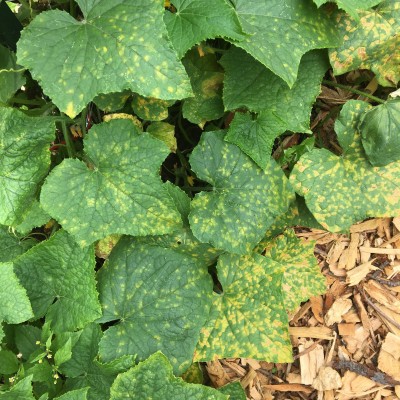
Cucurbit downy mildew (DM) has become a regular occurrence in NYC in recent years, effectively ending harvest of most cucumbers by late August. In 2023, two urban farms in NYC trialed a DM resistant cucumber variety, Brickyard, alongside Longfellow, a variety without known DM resistance. After the Longfellow succumbed to downy mildew in mid-August, the Brickyard remained highly productive for another 5 weeks with only mild DM symptoms.
Bacterial Leaf Spot on Peppers

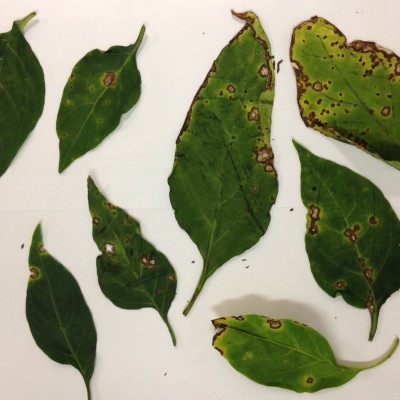
At a large rooftop farm built specifically to provide ingredients for hot sauce, hot peppers accounted for nearly 75% of the growing space. When bacterial leaf spot appeared, it spread quickly, reducing their harvest by over 25% in the first year. Crop rotation was a limited option given the farm’s focus on peppers, and chemical fungicides were not permitted by the landowner. In response, the farm tried two jalapeño varieties with resistance to bacterial leaf spot. For the next three years, bacterial leaf spot was nearly absent across the farm, causing no recorded yield losses.
Basil Downy Mildew

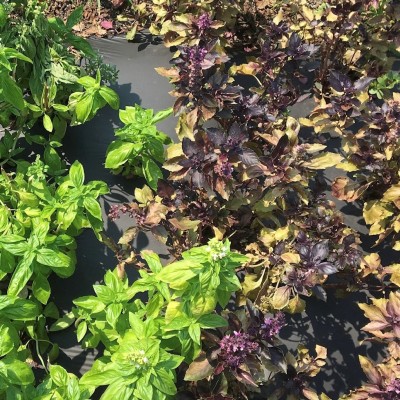
In 2018, basil downy mildew caused the complete loss of sweet basil (aka Genovese basil) at nearly all NYC urban farms by mid-August. Farmers across the city began adopting resistant basil varieties such as Prospera, Amazel, and Rutgers DMR, and saw immediate results. In 2020, only one out of 12 NYC farms scouted in August showed signs of basil downy mildew—even as neighboring gardeners with non-resistant varieties were losing their entire crop. 

Photo: An opal basil variety (right) is severely infected with basil downy mildew, while a resistant variety (left) persists with only minor symptoms.
Other Resources

While seed catalogs are a great starting point, you may want to check another source to gauge a variety’s potential resistance. Researchers find disease resistant vegetable varieties through traditional plant breeding, selecting the plants that fare best against specific pathogens. As those pathogens mutate, plant breeders continue selecting for updated resistance. This means that over time, an older variety may start to lose its disease resistance, but a new variety will often become available to replace it. It’s also important to note that disease resistant vegetable varieties are nearly always non-GMO, and often available as untreated or certified organic seed. 

For many urban vegetable farmers, disease prevention tools such as chemical fungicides—and even crop rotation—may be impractical or unavailable, making the remaining tools even more important. Selecting resistant varieties is an easy, cheap, and effective strategy to get ahead of plant diseases. Do a little extra homework when you buy seeds this winter; next summer, you’ll be glad that you did.

Prepared by

Sam Anderson, Urban Agriculture Specialist, CCE Harvest New York

Lori Koenick, Extension Support Specialist, CCE Cornell Vegetable Program

Judson Reid, Extension Vegetable Specialist, CCE Cornell Vegetable Program
 

This material is based upon work supported by the National Institute of Food and Agriculture, U.S. Department of Agriculture, through the Northeast Sustainable Agriculture Research and Education program under subaward number [LNE21-421 “Sustainable Pest Management for New York Urban Farmers”]. Fall 2024.