Share

After its first detection in North America near Lancaster, PA in 2015, this invasive insect pest originating from Europe quickly established itself in southeastern New York, New Jersey, western Massachusetts, Delaware and Connecticut. In the fall of 2023, Allium leafminer (ALM) decimated leek crops in Orleans, Genesee, and Niagara Counties in New York. We are now assuming that ALM occurs throughout the 14-county Cornell Vegetable Program region. And, unfortunately, it is here to stay. Here is what Allium growers need to know.
Two Generations Per Year – ALM is Not Active in the Summer
- ALM has a bimodal lifecycle, with one generation occurring in early spring and the other in the fall.
- Damage is higher in the fall than in the spring.
- ALM is not active during summer months (mid-June through early September).
- ALM overwinters as pupae in the soil and in allium crop debris.
- Adults begin to emerge as flies in early to mid-April. The flies are active until late-May.
- Fly activity includes mating, foraging and egg-laying.
- Flies are relatively weak fliers and only disperse short distances.
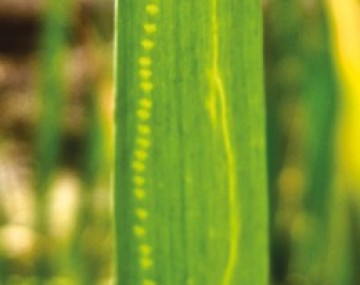
- Flies forage on the exudates that leak out of the leaves where females punch holes with their ovipositor (egg-laying apparatus). Very few of these holes contain eggs.
- Egg-laying begins 10-14 days after emergence and continues for a period of about 6 weeks.
- Eggs hatch into larvae, which feed/mine between the upper and lower leaf surface until the end of their development, at which time they pupate within the mine, or drop to the soil.
- Adult flies emerge from the summer pupa beginning in early to mid-September through the end of October.
- Egg-laying occurs from mid-September to late-October for a period of 6-8 weeks (longer in the fall than in the spring)
- In the fall, eggs hatch and larvae feed from late September through December.
- In the fall, larvae become pupae from late October to early-December and overwinter until they emerge as adults the following spring.
Specialist of Alliums, Most Damaging to Fall Leeks
- ALM only targets Allium species including cultivated, ornamental and wild species.
- ALM is most damaging to leeks and scallions in the fall, and to scallions in the spring.
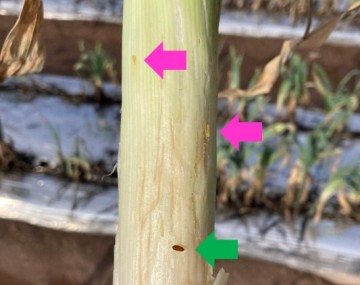
- The feeding/mining injury to the leaves can deem the leaves of leeks and scallions/chives unmarketable.
- ALM larvae and pupa squeeze between the leaves/scales and contaminate the marketable portions.
- Mining injury may allow bacterial rot pathogens in to infect and rot ALM-infested plants.
- ALM is the least damaging to direct seeded onions and shallots; these crops fall between the two ALM generations.
- In the spring, garlic may sustain some feeding/mining injury and although rare, it is possible that pupa can be captured within the wrapper leaves of garlic bulbs.
- Such pupal contamination is easily removed with the wrapper leaves.
- ALM flies may emerge from pupae stowed away in wrapper leaves of garlic bulbs. Care must be taken to not ship ALM-contaminated garlic bulbs for seed prior to September (when the flies will emerge from pupa).
- Losses due to ALM in garlic in NY have been very minor.
- Similarly, early-planted transplanted/set onions/shallots that have enough green foliage in early-May may sustain some ALM feeding/mining injury.
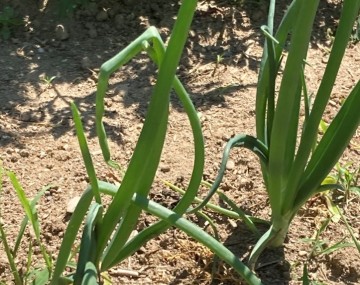
- ALM infestation of onion plants may cause leaf distortion and leaf splitting, which only on rare occasions reduces bulb quality (marketable portion).
- On very rare occasions, ALM larvae may survive long enough to be found in an onion bulb. However, when this does happen, the larvae and sometimes even pupae usually get squished between the scales and die. Dead ALM in onion bulbs are nearly impossible to see but would deem the bulb unmarketable.
- ALM can also cause distorted growth in scallions, but to a lesser degree than it does in onion.
The most important time to protect Alliums from ALM is during egg-laying.