

Share

Start thinking about succession planting. Once your spring crops like peas and spinach are done, you can replace them with some other quick-growing, heat-loving vegetables. And — even though it feels like summer’s only just started — think about starting some seeds for fall crops.
In the Garden
- Consider joining us for two classes to get you growing this month:
- July 5: Purposeful Pruning: Join Master Gardener Michael Klepp to learn proper pruning techniques to increase food production, reduce disease, help habitat and more. Also, find out the best ways to care for your tools and how to reduce the need to prune. Bring your pruners for hands-on experience! Part of our Master Your Garden education series, this class begins at 10 a.m. at the Orleans County Cornell Cooperative Extension Education Center, 12690 State Route 31, Albion. Suggested donation: $5. To register, call (585) 798-4265 or email klo54 [at] cornell.edu (klo54[at]cornell[dot]edu).
- July 19: Herb Gardening: Explore the fascinating world of culinary herbs. You'll learn essential cultivation techniques for growing healthy, productive herbs, plus proper harvesting methods. We'll also cover the best practices for preserving your herbal bounty through drying, freezing, and storing, ensuring you can enjoy your garden's gifts year-round. The class is part of our Seeds to Splendor education series. Stay after to explore the Orleans Community Seed Share, a seed library featuring vegetables, herbs, and flowers. The class begins at 10 a.m. in the Education Center at the Orleans County Cornell Cooperative Extension offices, 12690 Route 31, Albion. Suggested donation: $5. To register, call 585-798-4265 or email klo54 [at] cornell.edu (klo54[at]cornell[dot]edu).
- Remember to check out the Orleans Community Seed Share, a new seed library based at the Orleans County CCE offices in Albion.
- If you’re having trouble with your tomatoes, check out this handy tool to identify potential diseases and find solutions.
- Keep an eye out for pests like Japanese beetles, tomato hornworms, squash bugs and squash vine borers, as well as slugs and snails. Learn about other common garden pests.
- Mid-July is typically when garlic is ready to harvest. Watch for the bottom few leaves to brown and die back. That is usually a good indicator that your garlic is ready. But that’s not always the case. Here are some other ways to tell if your garlic is ready.
Around Your Yard
- Deadhead your annuals, but do a little research before deadheading perennials. Some of them reseed very well and if you want them to spread, consider holding off. Learn more about deadheading your flowers.
- Make note of areas in the garden that just aren’t thriving. Consider taking a soil sample and sending it in for analysis. A soil test can tell you what nutrients are in your soil, the state of its health or even if you have contaminants harmful to humans, plants or the environment.
- Together with healthy gardening practices, testing can lead to better management as well as safe and productive soils. Learn more about soil samples and testing.
- Prepare new beds for fall planting. Sheet mulching with cardboard can be an effective strategy for smothering grass to create a new area for plantings.
- Make sure annual vines — and even perennials like clematis — still have the support they need. Consider using wire, twine and lattice to hold your plants up. Continue to prune dead, diseased, weak or crossing branches in trees and shrubs. This is also a good time to prune evergreens. For more details on when and how to prune, check out this illustrated guide to pruning.
- Remember to water your plants deeply in the root zone, and keep an eye on containers especially. Try to water in the mornings and avoid wetting leaves to prevent disease and other issues.
- Keep an eye on trees during dry spells. Even more established trees can get stressed. Water them deeply and slowly.
- Stay on top of the weeds. They will compete with your plantings for water and other resources as the summer heats up. Check out this handy weed ID tool to identify what’s coming up in your yard.
- Stay ahead of hungry critters in your garden. In addition to planting resistant varieties, consider constructing fences or other barriers to protect your plants and trees.
Lawn Care
- In the high heat of summer, set your mower blades a bit higher. Mowing too low will allow crab grass to take hold. Keep grass at about 3-3.5 inches to ensure a healthy lawn.
- When your lawn starts to brown as the season heats up, let it go dormant. It will perk back up when the rain returns.
- If you have bare spots in your lawn, wait until the cooler conditions of fall to re-seed.
Enjoy Your Garden!
- As your annual and perennial flowers and shrubs continue to bloom, turn them into beautiful bouquets to keep or share. For fresh bouquets, harvest flowers early in the morning. For flowers you’d like to dry, harvest later in the day when the blooms are holding less water. Learn more about harvesting cut flowers.
- Harvest your herbs and start enjoying them. You can add them to fresh salads, garnish grilled dishes or start preserving them for winter.
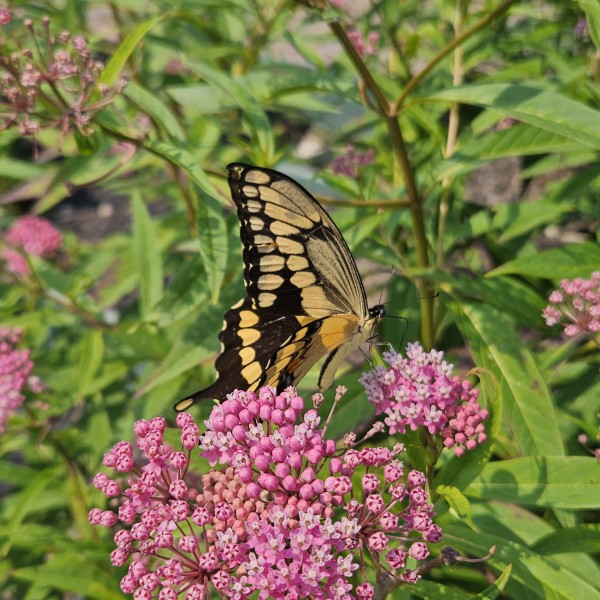
- Bring butterflies to your garden by giving them a place to drink. If you don’t have space for a fountain or other water feature, you can create a simple butterfly puddler with a shallow dish, some sand, soil and water.
Master Gardener Volunteer Column
My brain runs at warp speed all the time. It's almost always the many tasks I need to do. Instead of focusing on the here and now, I may be focusing on the next five tasks on my lists, and others for next week and next month… I need mindfulness...