
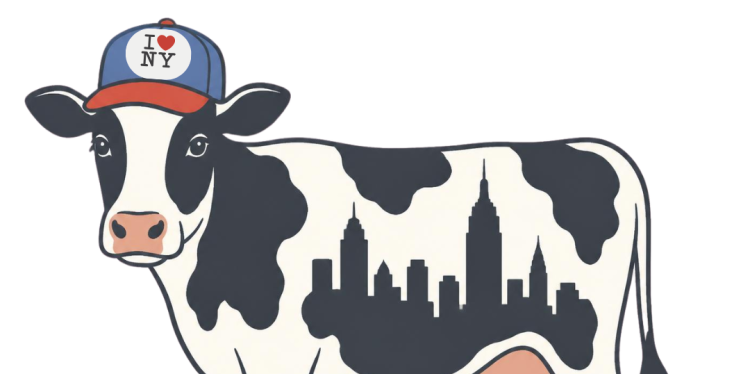
Welcome to Moo York: Agritourism on Dairy Farms

Last month, I tuned into a webinar hosted by the Cornell Cooperative Extension Agritourism Program Work Team. They featured Stacey Stearns, a Communications Specialist with UConn Extension who also helps operate her family’s dairy agritourism business. Stacey’s objectives for the webinar were to help farmers determine whether agritourism is a good fit for their farm and, if so, to highlight ways to add or enhance agritourism opportunities on their operation.
The webinar began by highlighting several large dairy farms that may come to mind when we think about agritourism. The four case study farms featured were Fair Oaks (Indiana), Kreider Farms (Pennsylvania), Hansen’s Dairy (Iowa), and Hillcrest Dairy Farm (Georgia). For those unfamiliar with the farms, I will share a few of the activities each offers. Fair Oaks has a Birthing Barn with stadium seating where visitors can watch calves being born. It also has a 2D Movie Theater that rotates through a variety of videos about the farm. Kreider Farms offers guided driving tours on a branded bus that takes visitors through the farm and concludes with a climb up a silo observation tower, where guests can enjoy beautiful views while sipping farm-fresh milk. Hansen’s Dairy emphasizes creating “a true Iowa farm-to-table experience,” allowing visitors to bottle-feed a calf and milk a cow. Last but not least, Hillcrest Dairy takes pride in being Georgia’s first robotic dairy farm and educates the public about sustainability and robotic milking practices. If these farms are your only examples of dairy agritourism, you might feel overwhelmed and conclude this type of agritourism could never work on your farm. You may even be right! However, not all agritourism operations have to look the same. Stacey then introduced four additional case study farms that offer much smaller-scale experiences while still providing meaningful value to consumers.
The first case study was Liberty Hill Farm in Vermont (LibertyHillFarm.com). They milk 115 cows and market themselves as a farm-stay destination. The farm features an inn with 7 bedrooms and 4 bathrooms, where guests are invited to stay and assist with what the farm describes as “family-friendly chores on the farm.” Now, I know what some of you may be thinking. As someone who grew up in Los Angeles, California, I can assure you that, yes, people will pay money to do things that many of us simply view as chores on the farm.
The next farm highlighted was Thorncrest Farm in Connecticut (MilkHouseChocolates.net). Their main attraction is fresh chocolates and creamline milk produced from the cows on their farm. To enhance the visitor experience, the cows are housed in a stable from 11 a.m. to 3 p.m., Thursday through Sunday, allowing guests to meet the named cows who helped produce the delicacies they are purchasing and enjoying.
Guardians Farm in Connecticut (GuardiansFarmDairy.com) was the third case study featured and is Connecticut’s only veteran-owned dairy farm. In addition to offering creamline milk delivery and a farm store, which are more traditional forms of dairy diversification, Guardians Farm has distinguished itself by offering calf-cuddling sessions. The owner has also combined his passion for photography with the farm experience by offering farm portrait sessions.
The final case study covered was Stacey Stearns’ family farm, Mountain Dairy in Connecticut (MountainDairy.com). Stacey shared that they recently opened an on-farm creamery and incorporated educational exhibits about milk and dairy cows throughout the facilities to help educate consumers. She also noted that they added “Instagrammable” photo opportunities, including a giant ice cream cone created by a local artist, to attract more visitors and encourage social media engagement.
These are just a few examples of real farms that have successfully made agritourism work for their operations. Stacey shared a slide highlighting a wide range of opportunities, including:
- Educational experiences: school tours, homeschool groups, on-demand tours, interactive exhibits
- Entertainment experiences: hayrides, festivals, family events, seasonal celebrations, calf days
- Food experiences: dairy tastings, ice cream, breakfast on the farm, cheese events
- Overnight experiences: farm stays, camping, RV sites, glamping
Despite the variety of opportunities she covered, Stacey emphasized that what visitors are really buying are memories, experiences, connections, and stories. Agritourism on your farm does not have to be elaborate or expensive, but it does have to work for you. She concluded the webinar by sharing a four-step action plan for anyone interested in exploring agritourism:
1. What assets do we already have?
2. What type of offerings are we comfortable with?
3. Who is our target visitor?
4. What can we launch in 12 months?
Dairy agritourism isn’t a one‑size‑fits‑all approach. The right path is the one that aligns with your farm’s strengths, comfort level, and long‑term vision.
News
As Fall sets in across the North Country, the growing season is coming to an end. Gardens are being cleared, farmers are bringing in the last crops of the season, and local markets are filled with the colors and flavors of fall. For many people...
Master Gardener Volunteer Column

We openly share valuable knowledge.
Sign up for more insights, discoveries and solutions.