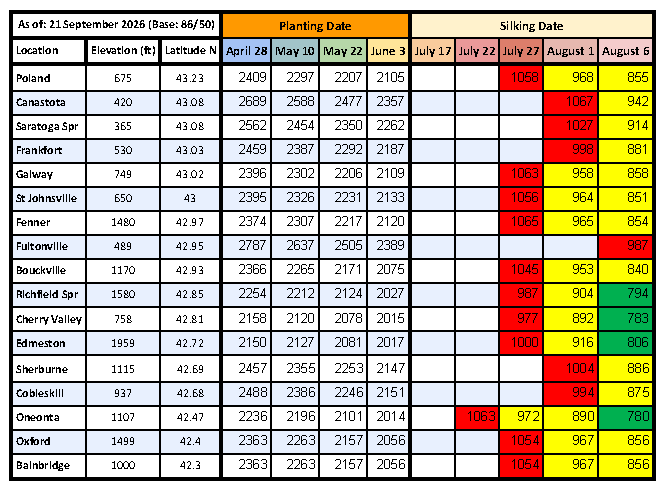
(See: Climate Smart Farming Growing Degree Day Calculator)
Growing degree days (GDD) are calculated by taking the average daily temperature and subtracting the base temperature for development of a given organism ((High + Low)/2 – base temp = GDD).
For corn, we use base 50/86, as corn development starts at 50 degrees F and ceases above 86F. Check your location and planting date for grain GDD.
For silage, we track GDD from silking. Silking in our region began mid-July and is continuing through the first half of August. Your crop may have tasseled on or more closely to one of these dates. So while our GDD tables can get you in the ballpark, check your own whole-plant DM to make sure you’re ready, and not ahead/behind schedule!
Remember: Silage corn needs 750-800 GDD (depending on hybrid maturity) after silking to reach a whole plant DM of 32%. Under typical late season dry down conditions we can expect the crop to reach 35% DM four to seven days later. We can expect to accumulate 15-25 GDD per day, or even up to 30, so peak maturity can creep up on us quickly. But no matter what the numbers say, always check your crop to see how close you may be to harvest. For more details, see this article.
| Hybrid relative maturity | GDD from silking to reach ~32% DM |
| 101-110 | 800 |
| 96-100 | 750 |
| <96 | 750 or slightly less |
Silking date / silage forecast GDD color key (BALLPARK ONLY - these are based on corn development from silking at GDD (which is the best sight-unseen forecasting method we have, but still has limitations):
Blue: Time to make plans (32-35% DM anywhere between 5 – 11 days from now, depending on maturity).
Green: Gas up the harvester and the trucks (32-35% DM in 2 – 8 days, depending on maturity).
Yellow: See you in the field soon (32-35% DM imminently).
Red: It’s either already in the bunk or it’s eventually going for high-moisture corn or grain (DM likely closer to 40%).